
Every December, It’s a Wonderful Life finds its way back onto our screens.
Black and white. Snow drifting down on Bedford Falls. A bell ringing. Angels getting wings—which, quick sidebar, please don’t build your theology of angels from Frank Capra.
But at the center of the story is George Bailey—exhausted, overwhelmed, quietly convinced that his life hasn’t amounted to much. He isn’t asking for wealth or fame. He’s asking a far more honest question:
Did my life matter?
Not in a highlight-reel kind of way. But in the slow years…the unnoticed faithfulness. The ordinary obedience.
George doesn’t want a miracle—he wants proof that his waiting wasn’t wasted.
And that question isn’t just George Bailey’s.
It’s ours.
As the world rushes toward celebration—toward lights and songs and wrapped gifts—many of us are quietly asking if anyone sees us. Some of us are eve wondering if God sees us at all. If He remembers His promises. If the long obedience in the same direction—the years of faithfulness, the prayers that seem unanswered, the waiting that has stretched far longer than we expected—actually means anything.
That’s where Simeon meets us.
Waiting with a Promise—and No Timeline
Luke introduces Simeon with almost startling simplicity:
“Now there was a man in Jerusalem, whose name was Simeon, and this man was righteous and devout, waiting for the consolation of Israel…” (Luke 2:25)
No résumé or list of accomplishments. Just righteous, devout…and waiting.
Luke tells us Simeon was waiting for the consolation of Israel. And that word matters. Consolation isn’t excitement or triumph. It’s comfort after loss. Relief after grief. It’s what you long for when sorrow has lingered too long.
Simeon wasn’t waiting for a political revolution or a cultural comeback. He was waiting for God to step into suffering and finally say, “Enough.”
And then Luke adds one more detail:
“…it had been revealed to him by the Holy Spirit that he would not see death before he had seen the Lord’s Christ.” (Luke 2:26)
That’s a staggering promise.
And also a painfully vague one.
No timeline—no expiration date. No sense of whether this would take weeks…or decades.
Just a promise—and the slow, steady ticking of time.
And that’s often where faith becomes most difficult. Not when God speaks—but when He doesn’t explain. Not when God promises—but when He delays.
Because waiting presses on us.
We start asking questions we don’t want to admit out loud.
Did I hear God right? Did I misunderstand? Is God slow?
Or worse…Has He forgotten me?
Simeon lived in that tension year after year. Probably decade after decade. Watching his body age. Watching empires rise and fall. Watching life move forward while the promise seemed to stand still.
And yet, Luke tells us Simeon remained righteous and devout.
Time didn’t erode his trust. Delay didn’t turn into disbelief. Obedience didn’t harden into bitterness.
God’s unbroken promises teach us to trust—even when the clock keeps ticking.
Trust isn’t proven when God fulfills His promises. Trust is formed when He delays them.
It’s easy to trust God when prayers are answered quickly, when clarity comes easily, when the path forward feels obvious. But trust is forged in the long middle. In the quiet years. In the seasons where obedience feels repetitive and hope feels fragile.
Simeon didn’t just trust God with belief—he trusted Him with time. And time may be the hardest thing we ever surrender.
We’re often willing to trust God with doctrine and theology and Sunday mornings. But trusting Him with years? With seasons? With the ticking clock of our lives?
That’s different.
You’re Not Behind
There’s a website I once stumbled across—one of those “Things Other People Accomplished When They Were Your Age” generators. I do not recommend it unless you enjoy existential spirals.
I put in my age and learned that by my age:
- Robert Fulton had developed the steamboat.
- James Marshall had discovered gold in California.
- Neil Armstrong had walked on the moon.
- Robert Frost had sold his farm, moved to England, and devoted himself to writing—which, apparently, made all the difference.
- And after a few months of home workouts, Linda—whoever Linda is—was doing 280 push-ups on her toes.
Good for Linda.
But here’s the thing: none of that means I’m behind. None of it means God’s promises are broken because certain things haven’t happened by a certain birthday.
Advent reminds us that God’s promises are not broken by time. They are often revealed through time.
Delay does not mean denial…silence does not mean absence…waiting does not mean wasted.
The same Spirit who spoke the promise to Simeon sustained him through the waiting. And that’s good news—because many of us are living right now between promise and fulfillment. Still praying. Still hoping. Still showing up.
Advent doesn’t rush the process. It invites us to trust the God who keeps His word.
Persevering in the Ordinary
Luke tells us, almost in passing:
“And Simeon came in the Spirit into the temple.” (Luke 2:27)
It’s easy to miss how remarkable that is.
After years of waiting and decades of ordinary days. After countless mornings that looked exactly like the ones before—Simeon is still listening.
That may be the quietest miracle in the story.
He hasn’t numbed himself to God’s voice. He hasn’t lowered his expectations just to avoid disappointment. Perseverance, in the kingdom of God, rarely looks dramatic. It looks like paying attention. It looks like faithfulness in repetition. It looks like continuing to show up when nothing seems to change.
Simeon doesn’t go to the temple because he knows something extraordinary will happen that day. There’s no sign in the sky. No dream the night before. He goes because he’s learned to move when the Spirit nudges—even when the nudge feels small.
And when he arrives, he doesn’t find a king or a warrior…not even a prophet.
He finds a baby. Held by a poor couple offering the sacrifice of those who couldn’t afford a lamb.
Nothing about this moment looks impressive. And yet, by the Spirit, Simeon knows: This is it.
Come Thou Unexpected Jesus
God’s timing almost never looks like our expectations. We imagine something loud and unmistakable. God’s timing often arrives quietly, disguised as ordinary obedience.
And then Simeon takes the child into his arms.
The promise he’s waited for his entire life is small enough to hold. Fragile and dependent.
Perseverance isn’t gritting your teeth and pushing through. It’s staying responsive. Staying present. Continuing to pray when prayers feel repetitive. Continuing to worship when emotions feel thin. Continuing to obey when progress feels stalled.
Waiting doesn’t mean nothing is happening. Often, it means something is being formed.
As John Piper once said:
“God is always doing 10,000 things in your life, and you may be aware of three of them.”
Perseverance keeps us from missing the moment when something finally begins to happen. And it prepares us for what comes next—because God’s timing doesn’t just teach us how to keep going. It teaches us how to receive what He has promised.
Peace at the Fulfillment
When Simeon takes the child in his arms, he praises God:
“Lord, now you are letting your servant depart in peace, according to your word.” (Luke 2:29)
Simeon’s peace isn’t rooted in circumstances or comfort. It’s rooted in the faithfulness of God.
God did exactly what He said He would do. The promise has become a person. Not an idea. Not a theory. A child in his arms.
“For my eyes have seen your salvation.” (Luke 2:30)
Not will see. Not someday. My eyes have seen.
Simeon never saw Jesus preach or heal or be crucified or rise again. He never saw the full story unfold. But he saw salvation in seed form—and that was enough.
God often fulfills promises in ways larger than we expect. The thing we think is about us is often about generations…about the world God is redeeming.
Persistence gives us perspective. Simeon sees that his waiting wasn’t wasted—it was woven into God’s story. Sometimes fulfillment looks like answered prayers. Sometimes it looks like peace without all the answers. But often, it looks like trusting that God has kept His promise—even if you don’t get to see every outcome.
That’s why Advent matters.
We have seen the salvation of God—and yet we are still waiting for Christ to return and make all things new. We live between fulfillment and completion.
The Final Word of Advent
In It’s a Wonderful Life, George is shown what the world would look like if he had never existed.
In the temple that day, Simeon is shown what the world will look like because this child exists.
And suddenly, all the waiting makes sense.
Advent’s final word isn’t hurry, anxiety, or fear.
It’s peace.
The peace that comes from knowing God is faithful. That He keeps His promises. And that no season of waiting is ever wasted in His hands.
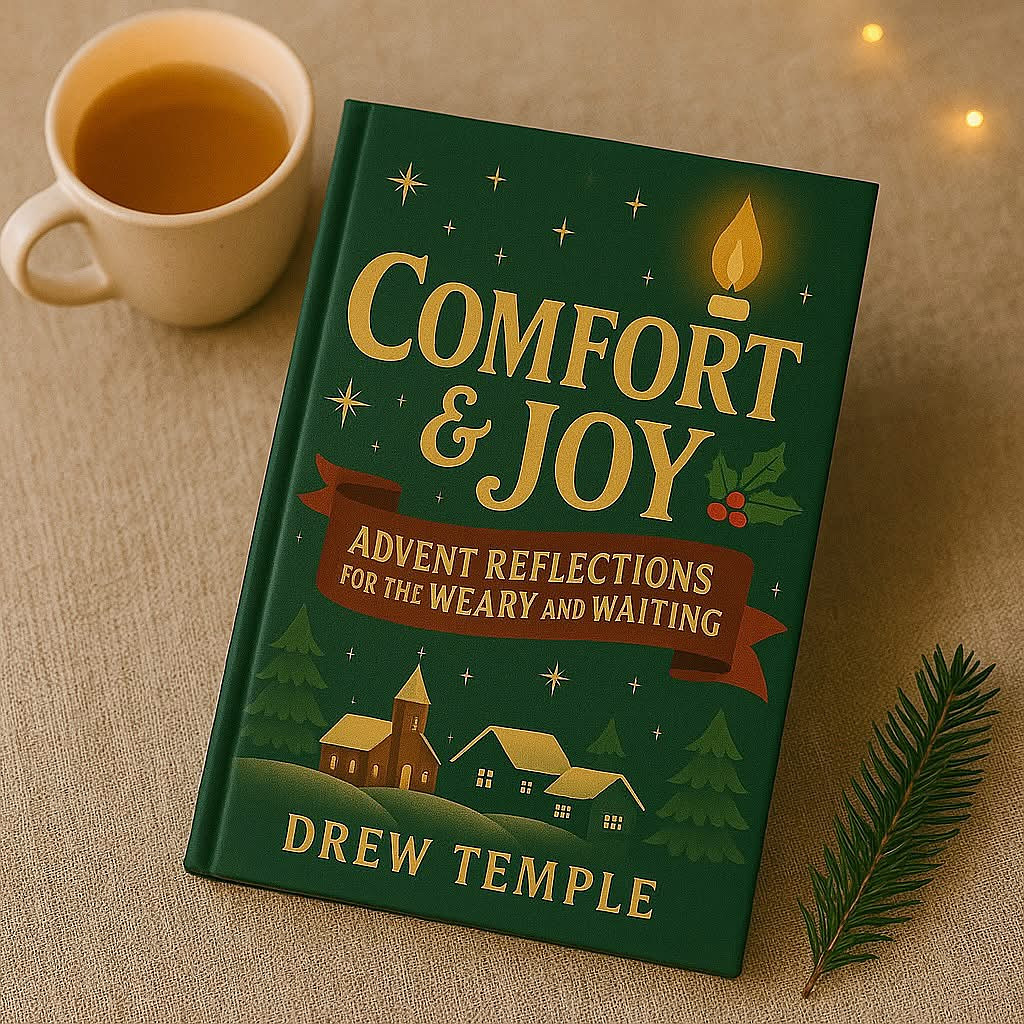
To read more on Advent, head over to Amazon to get your copy of my book, “Comfort & Joy: Advent Reflections for the Weary and Waiting”

 Pillar & Page
Leave a comment